Event
Joshua Steckley
Date
Time
Tuesday, March 17 from 3pm to 5pm EST
Location
Ontario Institute for Studies in Education (OISE), Room 3311, 252 Bloor Street West, Toronto, ON M5S 1V6
Nightcrawler Commodities: an eccentric tale of worms, cows, cash, and capitalism
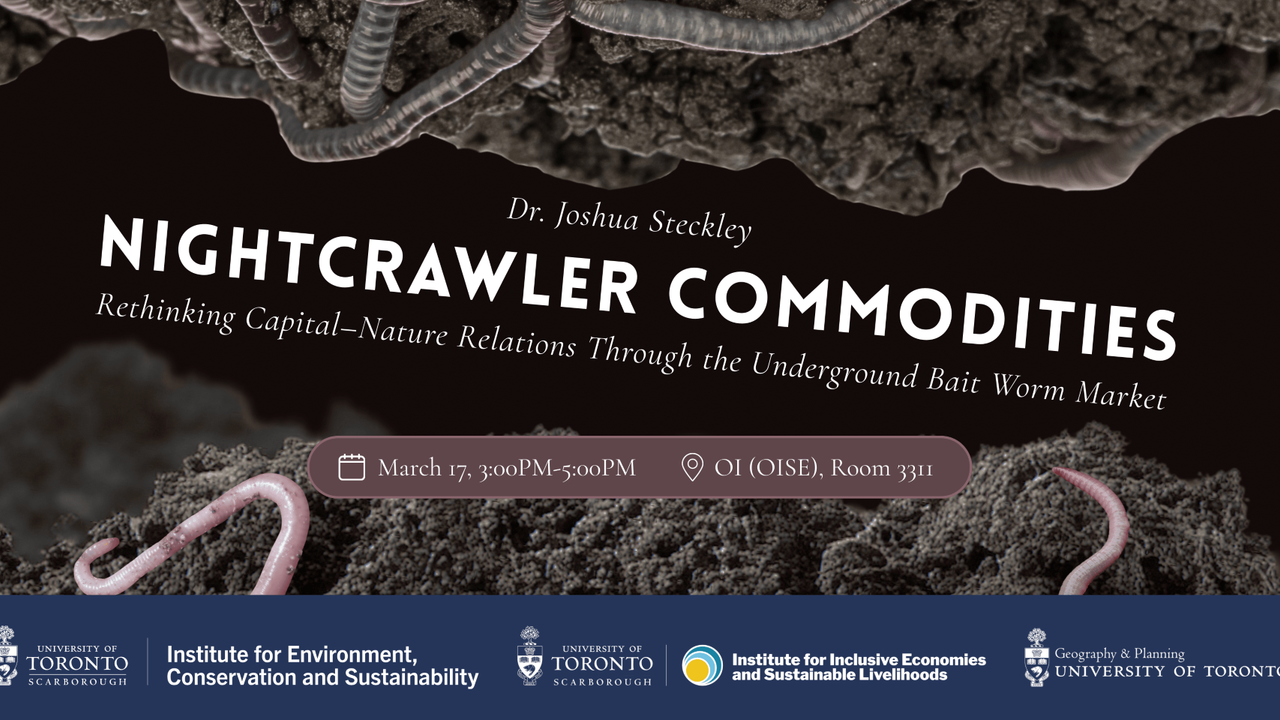
Nightcrawler Commodities: A lecture by Dr. Joshua Steckley
When: Tuesday, March 17 from 3pm to 5pm EST
Where: Ontario Institute for Studies in Education (OISE), Room 3311, 252 Bloor Street West, Toronto, ON M5S 1V6
This event is free to attend, but space is limited—be sure to register early to secure your spot. EVENTBRITE link
Rethinking Capital-Nature Relations through the Underground Bait Worm Market. How does a banal earthworm become a valuable commodity?
The ‘Canadian nightcrawler’ is the most popular live bait used by recreational anglers throughout the world. Each year, as many as 700 million worms are handpicked from Ontario farmland for the bait market, earning the region the undisputed title of ‘worm capital of the world.’
The Nightcrawlers (University of California Press, 2025) goes deep into the empirical underground to see how capital confronts a diverse cast of human and nonhuman characters: stubborn worms, wealthy dairy farmers, immigrant pickers labouring at night, and worm wholesalers who undercut each other through tax fraud and money laundering.
This eccentric tale of worms, cows, and cash reveals the inherent contradictions in capitalism’s attempts to commodify the living world— including the soil organisms that are inches beneath our feet.
Joshua Steckley is a Banting postdoctoral fellow at Carleton University. He completed his PhD in the Department of Geography at the University of Toronto. His forthcoming book, The Nightcrawlers: A Story of Worms, Cows, and Cash in the Underground Bait Industry, (UC Press) examines the political ecology of the lucrative bait worm industry and tracks how southwestern Ontario accidentally became the ‘worm capital of the world.’ Prior to his academic work, Joshua spent over 5 years in Haiti working with local environmental organizations and promoting local food systems through the production of documentaries, community radio broadcasts and Haitian television commercials. He continues to publish on Haitian rural food systems through a CIHR grant, “Towards a gender-inclusive food sovereignty assessment.”
Co-sponsored with the Institute for Inclusive Economies and Sustainable Livelihoods.